In the roaring industrial workshops, equipment such as machine tools, injection molding machines and hydraulic systems operate at high speed. Besides precise mechanical movements, there is an easily overlooked yet crucial invisible guarantee — temperature control. And the oil cooler is exactly an indispensable cooling powerhouse in industrial production.
Many people may wonder: There are many ways to cool industrial equipment, so why are oil coolers absolutely essential? The answer is straightforward. In a wide range of industrial scenarios, the cooling efficiency, stability and compatibility of oil coolers are irreplaceable by other cooling methods. Today, let’s step into the industrial production site to explore the rigid cooling scenarios that can only rely on oil coolers, and understand the core value of oil coolers.
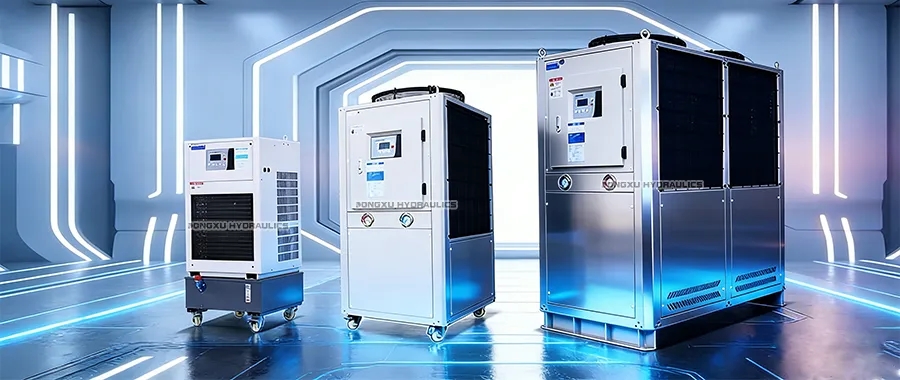
Why Do Oil Coolers Become the Main Force of Industrial Cooling?
Before discussing specific application scenarios, let’s first clarify the core advantages of oil coolers. As professional cooling equipment in industrial production, oil coolers gain solid market footing mainly owing to the following three strengths:
• Precise temperature control and higher stability
Oil coolers can accurately maintain the oil temperature within the set range, free from the influence of ambient temperature fluctuations, and prevent equipment failures caused by temperature imbalance.
• Imported core components with outstanding performance
The main unit adopts well-known imported compressors from Europe, America and Japan, featuring reliable and efficient operation with low noise. Equipped with high-quality imported oil pumps, it delivers strong pressure, high stability and long service life. The core hardware ensures long-term and stable equipment operation.
• Constant oil temperature to guarantee machining accuracy
It effectively avoids the impact of oil temperature fluctuation on equipment machining precision, prevents oil deterioration under high temperature, keeps oil viscosity stable, ensures continuous and stable operation of mechanical equipment, and prolongs the service life of both hydraulic oil and equipment.

 GearboxesAgriculture/Products8
 GearboxesAgriculture/Products8